
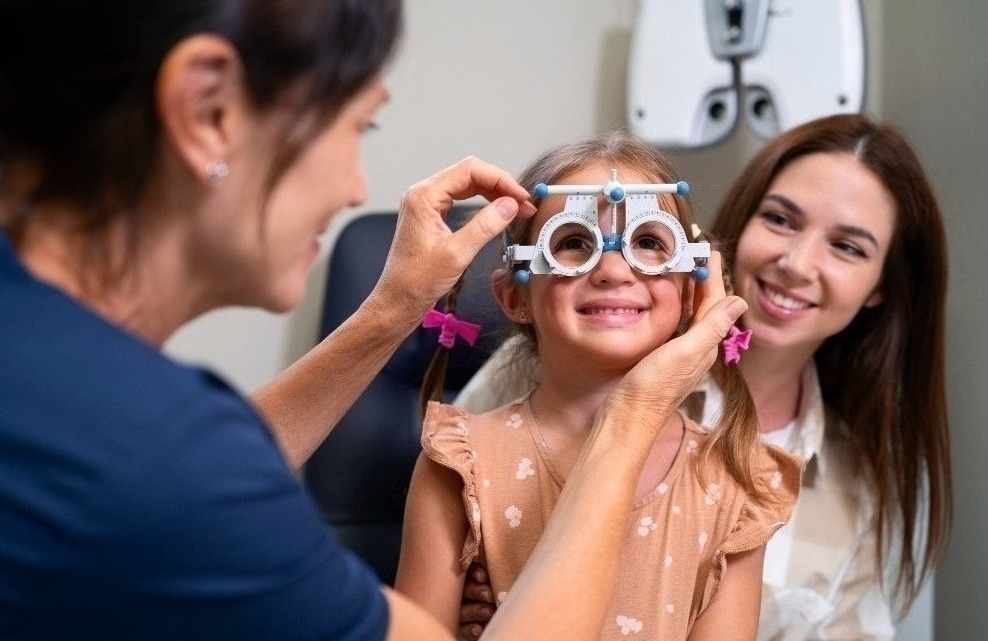
When a child struggles to read, copy from the board or maintain attention during visually demanding activities, the problem is not always academic. Sometimes an unrecognised vision issue can make classroom tasks more difficult.
This is where Pediatric Vision Care becomes relevant. An age-appropriate eye examination can help determine whether eyesight or eye alignment is contributing to the child's difficulties.
Signs Can Be Easy to Misinterpret
A child experiencing blurred vision may compensate in ways that parents and teachers interpret as habits.
For example, the child may:
Move closer to the classroom board
Lose their place while reading
Avoid books requiring prolonged concentration
Squint when looking into the distance
Complain of headaches after school
Tilt their head while watching television
Close one eye during detailed tasks
These behaviours do not prove that an eye condition is present, but they provide a reasonable basis for an eye examination.
Refractive Errors Are One Possible Cause
Myopia, hyperopia and astigmatism can affect how clearly a child sees. Depending on the type and severity of refractive error, difficulties may be more noticeable for distance viewing, near work or both.
Appropriate spectacles can help when refractive error is responsible, but an examination is needed to identify the correct issue.
Squint and Amblyopia Need Different Attention
A visible eye turn, commonly called squint, may occur constantly or intermittently. In some children, unequal vision between the two eyes can contribute to amblyopia, often called lazy eye.
These conditions require assessment rather than simply purchasing spectacles based on a basic vision screening.
Screening and Comprehensive Examination Are Different
School vision screening can identify some children who may need further evaluation, but it is not necessarily equivalent to a comprehensive pediatric ophthalmology assessment.
Families around Bannerghatta Road in Bengaluru, Karnataka, can consider a detailed examination when a child has persistent visual symptoms, abnormal eye alignment or repeated difficulty with school-related visual tasks.
Akshara Eye Hospital provides children's eye evaluation for families seeking pediatric ophthalmic care. The goal of an assessment is to understand whether the child's vision is developing appropriately and whether treatment, spectacles, monitoring or further investigation is needed.
Good vision cannot solve every learning difficulty, but identifying an undetected eye problem removes one potentially important barrier to comfortable learning.