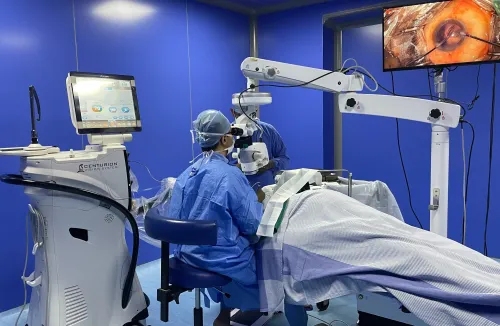


Patients diagnosed with retinal disease may hear terms such as laser treatment and intravitreal injections during their consultation. Both are established approaches used in retinal care, but they are not interchangeable.
Whether Retinal Laser Treatment, injections or another form of management is considered depends on the underlying retinal condition and examination findings.
What Does Retinal Laser Treatment Do?
Retinal laser uses controlled laser energy to treat specific areas of retinal tissue.
Depending on the condition, laser may be considered for certain retinal tears, diabetic retinal changes and other selected retinal problems. The purpose and treatment pattern vary considerably according to the diagnosis.
Laser treatment does not mean that every retinal condition can be permanently corrected with one procedure. Follow-up remains important.
How Are Retinal Injections Different?
Intravitreal injections deliver medication directly into the eye.
They may be used for conditions involving abnormal blood-vessel activity, retinal swelling or macular disease. Anti-VEGF medicines are among the treatments commonly associated with retinal injection therapy, although the exact medication depends on the diagnosis.
Some patients require repeated treatment because retinal diseases can remain active or recur.
Which Treatment Is Better?
There is no universal "better" option.
The correct question is which treatment addresses the specific retinal problem. For some conditions, observation may be appropriate. Others may require laser, injections, surgery or a combination of approaches.
The decision may depend on:
- Location of retinal changes
- Severity of disease
- Presence of macular swelling
- Type of abnormal blood vessels
- Previous treatment response
- Overall eye health
A retinal examination and appropriate diagnostic imaging provide the information needed to make this distinction.
For patients around Bannerghatta Road in Bengaluru, Karnataka, Akshara Eye Hospital provides retinal assessment where treatment recommendations can be based on individual clinical findings.
Patients should ask what the proposed treatment is intended to achieve, whether repeat sessions may be needed and what follow-up schedule is recommended. Understanding the reason behind a retinal procedure makes it easier to participate actively in ongoing eye care.