
A five-star rating cannot tell you whether a clinic can assess a preverbal child, confirm a squint, monitor amblyopia or arrange safe surgery. Use the comparison points below to match your child’s needs with the right professional, examination methods, follow-up plan and urgent-care pathway.
Key takeaways
- Match the specialist to glasses, squint, amblyopia, myopia or surgical needs.
- Ask whether the clinic examines children at your child’s age.
- Seek urgent review for sudden vision loss, severe eye pain or eye injury.
- Compare examination steps, follow-up plans and access before booking.
What should you compare when choosing pediatric eye care in Bannerghatta Road?
There is no single clinically meaningful best pediatric ophthalmologist in Bannerghatta Road: the right choice depends on whether your child needs glasses, alignment care, amblyopia treatment, myopia monitoring or surgery. Compare the service against the child’s diagnosis and likely outcome, not its label or star ratings alone.
| Criterion | Stronger service | What to verify |
|---|---|---|
| Training and testing | Formal pediatric ophthalmology training; experience from infants to teenagers | Can children who cannot read be tested with pictures, symbols or instrument-based methods? |
| Examination quality | Pediatric alignment testing, suitable diagnostic equipment and enough appointment time | Does the doctor assess alignment, eye movements, pupils, refraction and the retina? |
| Continuity | Child-friendly explanations, orthoptic or amblyopia follow-up and easy appointment access | Who records visual acuity and manages patching, glasses or atropine? |
| Safety pathway | Emergency review and named referral routes | Where would the child receive urgent review, pediatric anesthesia or surgery? |
Before booking, ask:
- Does the doctor perform pediatric alignment testing?
- Is cycloplegic refraction available when accommodation could hide the true prescription?
- Does the service provide orthoptic or amblyopia follow-up?
- Where would my child receive urgent review, pediatric anesthesia or surgery if required?
For myopia, ask whether the clinic documents axial length or another progression measure. Compare its advice on at least two hours outdoors daily, near-work habits, specially designed lenses and low-dose atropine. Outdoor time helps prevent or control myopia; it does not replace examination or prescribed treatment.
Which eye specialist should your child see?
Choose an eye specialist for kids according to the problem, not the clinic’s rating. Pediatric ophthalmology services are designed for developing vision, limited cooperation and conditions that need child-specific follow-up.
| Professional | Best suited to | What they assess |
|---|---|---|
| Optometrist | Routine screening or straightforward glasses assessment without warning signs | Visual acuity, refraction and glasses prescription |
| General ophthalmologist | Eye disease across age groups | Diagnosis and treatment of common medical eye conditions |
| Pediatric ophthalmologist | Squint, amblyopia, congenital conditions and child-specific surgery | Developing visual systems, alignment, cooperation, refraction and surgical care |
Choose a pediatric ophthalmologist for:
- A new or persistent squint, wandering eye or unequal vision
- Suspected lazy eye, an abnormal examination or a failed school screening
- A congenital eyelid or tear-duct problem
- Pediatric cataract, glaucoma or a retinal concern
A glasses-only visit is incomplete when amblyopia is suspected. Treatment can include glasses, patching the better-seeing eye or atropine penalization; the plan depends on the child’s age, cause, severity and response. The clinician must monitor visual acuity after correcting the prescription.
For a child who failed school screening, arrange a full eye examination rather than assuming the result only means new glasses. Arrange earlier advice when a parent, sibling or close relative had childhood eye disease, because inherited risk can change the timing of assessment.
What happens during an age-appropriate children’s eye examination?
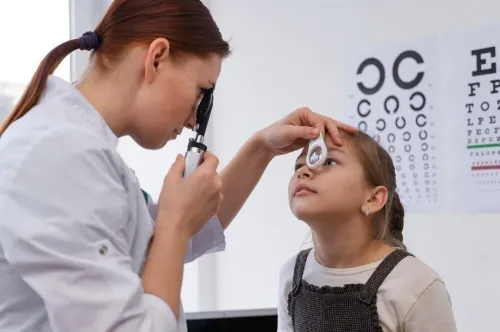
A complete children’s eye examination changes with age, but it should assess more than whether a child can read letters.
| Age | Possible testing methods | What the clinician checks |
|---|---|---|
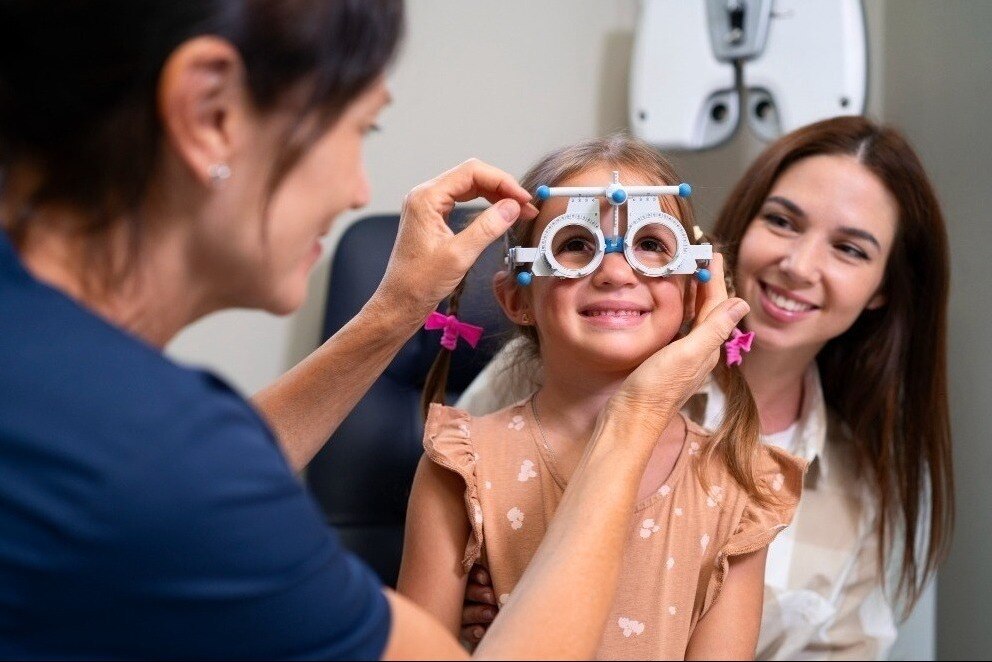
| Infants and toddlers | Preferential-looking, fixation and following behaviour, picture-based symbols or instrument-based screening | Vision in each eye, alignment, eye movements, pupils and the front and back of the eye |
| Preschool children | Matching symbols, pictures or familiar objects | Visual acuity in each eye, alignment, motility, pupils and eye health |
| School-age children | Matching symbols or letters, followed by standard acuity testing when suitable | Acuity, refraction, alignment, eye movements, pupils and anterior- and posterior-segment health |
Cover testing helps identify true strabismus rather than a false appearance caused by the eyelids or nose. Refraction detects unequal prescriptions, while dilation may be needed to inspect the retina or obtain an accurate prescription.
Cycloplegic refraction uses drops to temporarily relax accommodation. Without it, a child’s focusing effort can make farsightedness appear smaller and produce an inaccurate glasses prescription.
Ask these questions when comparing pediatric ophthalmology services:
- How will you keep the child comfortable during testing and drops?
- How long will the drops take to work, and when will you explain the results?
- For suspected squint, do you assess motility, refraction and amblyopia rather than relying on photographs or a quick autorefractor reading?
- What alternative methods are available if developmental delay or limited cooperation prevents chart testing?
These details matter in any children eye care comparison, because a service must adapt the examination rather than end it when cooperation is difficult.
Which symptoms require an examination, and which require urgent review?
Book an examination even if your child denies blurred vision. Amblyopia and refractive error often go unnoticed because one eye compensates for the other, so an eye specialist for kids should assess signs that affect behaviour, posture or learning.
Arrange an assessment for:
- An abnormal head posture or closing one eye
- Frequent eye rubbing or sitting unusually close to screens
- Headaches or poor school performance
- A wandering eye or persistent eye turn
Do not wait for a routine appointment when you see these signs:
| Sign | Action | Reason |
|---|---|---|
| Sudden or unexplained visual loss, new drooping eyelid | Seek prompt ophthalmic assessment | Delay can indicate serious disease |
| Severe eye pain, marked redness with light sensitivity, or trauma | Obtain urgent review | Painful red eyes and injuries need examination |
| Chemical exposure | Flush with clean running water while arranging emergency care | Do not delay because the eye looks better |
| White pupil or white reflex in a photograph | Seek urgent assessment | Retinoblastoma and other intraocular disease can cause it; do not blame camera artefact |
A pediatric cataract also needs timely referral because delayed treatment can disrupt visual development. After surgery, compare who provides refractive correction, amblyopia treatment and repeated examinations, not just surgical access.
Ask about pediatric anesthesia assessment, monitoring, recovery facilities and the referral destination for urgent complications when comparing the best pediatric ophthalmologist services for children in Bannerghatta Road.
How can you build a practical Bannerghatta Road shortlist?
A practical shortlist starts with the child’s reason for care: failed screening, glasses, suspected amblyopia, squint, allergy, congenital condition, myopia progression or possible surgery. There is no single best pediatric ophthalmologist in Bannerghatta Road; the right service depends on the diagnosis and follow-up required.
Call two or three services and ask:
- Will a pediatric ophthalmologist examine the child?
- Is picture-based or other age-appropriate testing available?
- Are cycloplegic refraction, dilation and alignment testing offered when clinically indicated?
- How is visual acuity recorded at follow-up?
- Who manages patching or atropine plans, and how is myopia progression measured?
- What is the urgent-care number, same-day review process and referral route for pediatric anesthesia or surgery?
Compare the answers this way:
| Question | Strong answer | Warning sign |
|---|---|---|
| Pediatric assessment | A named pediatric ophthalmologist examines the child | The service cannot confirm who will examine them |
| Amblyopia care | Orthoptic or visual-development follow-up tracks each eye | Glasses are supplied without acuity monitoring |
| Myopia monitoring | Progression is measured and reviewed over time | Advice relies only on a quick prescription check |
| Urgent care | The clinic explains same-day review and surgical referral | Staff cannot identify where urgent care occurs |
Akshara Eye Hospital belongs on the same evidence-based comparison: judge its answers against the child’s need, not its name or ratings. Ask when the child should return after an abnormal test; the interval must reflect age, diagnosis, treatment and severity. The strongest choice completes the assessment, explains the findings and maintains follow-up through visual development.
Related service
Paediatric Ophthalmology Akshara Eye Hospital in Bangalore offers specialized Pediatric Ophthalmology Services to address a wide range of eye conditions in children. View service → |
Frequently asked questions
What should you compare when choosing pediatric eye care in Bannerghatta Road?
Compare the specialist’s experience with your child’s condition, age-appropriate examination methods, treatment options, follow-up plan and surgical support when needed.
Which eye specialist should my child see?
Choose a pediatric ophthalmologist for children with squint, amblyopia, unusual visual development or complex eye conditions. An optometrist may manage routine vision testing and glasses, while an ophthalmologist provides medical and surgical care.
What happens during an age-appropriate children’s eye examination?
The clinician checks vision in each eye, eye alignment, movement, focusing and the eye structures. Drops may be used to measure the prescription accurately, especially when a child cannot describe blurred vision.
Which symptoms require an examination, and which require urgent review?
Book an examination for headaches, squinting, sitting close to screens, an eye turning in or out, a white pupil or suspected poor vision. Seek urgent review for sudden vision loss, severe eye pain, a chemical exposure, penetrating injury or new double vision.
How can you build a practical Bannerghatta Road shortlist?
List clinics that match your child’s likely need, confirm appointment availability and child-friendly testing, ask about referral and follow-up arrangements, then compare travel time and access to urgent care.